AuthKit
A drop-in auth microservice — one Spring Boot API, two interchangeable clients.
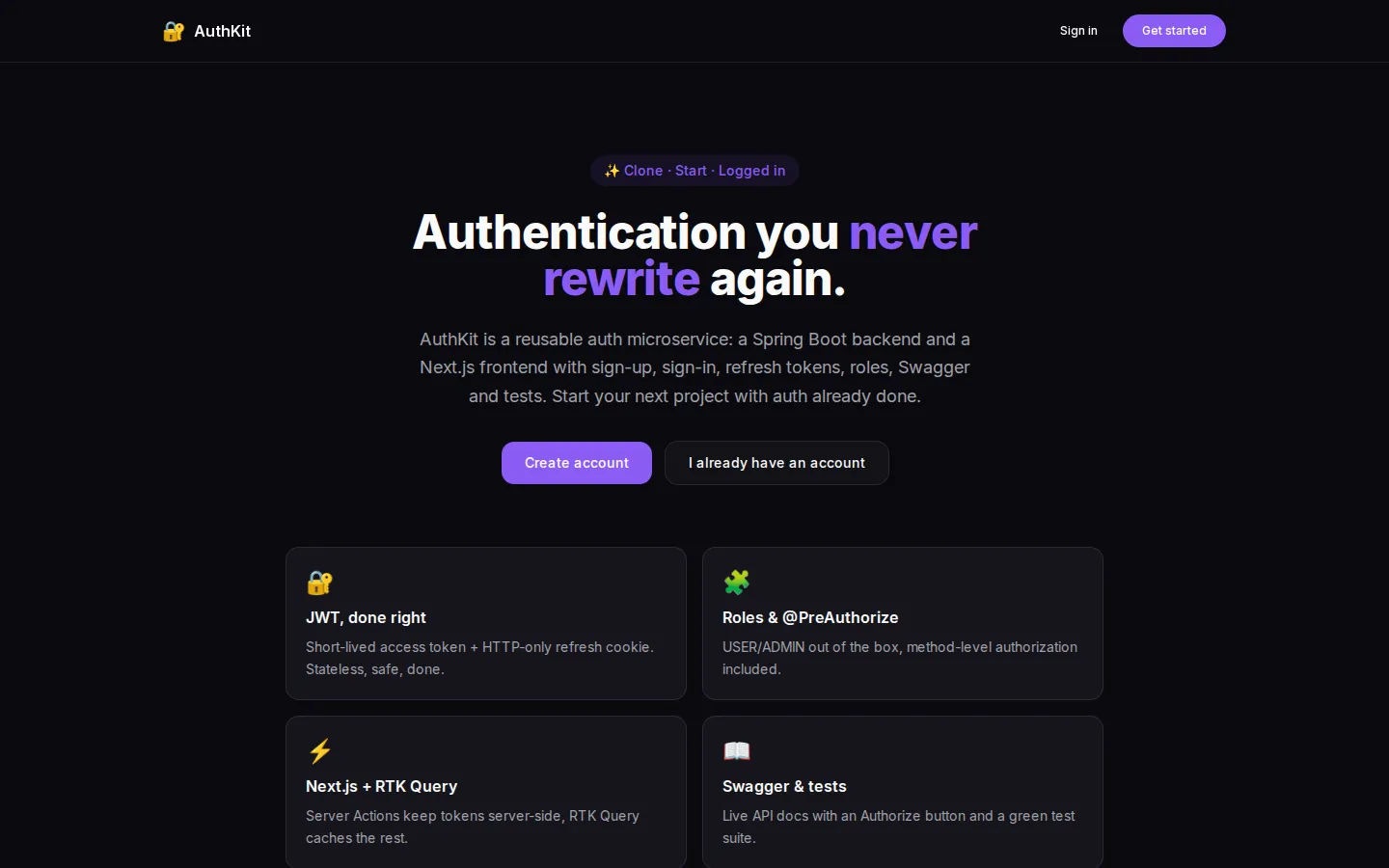
overview
A reusable, drop-in authentication microservice — clone it, start it, and you have working sign-up, sign-in, JWT sessions, roles, Swagger and tests on day one. A Spring Boot backend with two interchangeable frontends, a Next.js web app and a React Native (Expo) app, that implement the same production-style auth flow. Written from scratch after months of working through JWT in depth.
highlights
- 01JWT in depth: HS256 with a shared secret and RS256 with a private / public key pair
- 02Short-lived access token (15 min) + refresh token (30 days) in an HTTP-only cookie
- 03Stateless SecurityFilterChain with JwtAuthFilter before UsernamePasswordAuthenticationFilter
- 04Role-based authorization (USER / ADMIN) via @PreAuthorize, protected GET /me
- 05Next.js 16 proxy.ts route protection + Server Actions; RTK Query silent refresh on both clients
- 06Tests everywhere: JUnit 5 + MockMvc, Vitest + Testing Library, Playwright e2e — one docker compose up to run
how it fits together
- Next.js · Expo
- RTK Query
- JwtAuthFilter
- Spring Boot
- PostgreSQL
key files
apps/backend/…/auth/security/config/SecurityConfig.java
@Configuration
@EnableWebSecurity
@EnableMethodSecurity // enables @PreAuthorize("hasRole('ADMIN')") and friends
public class SecurityConfig {

    /**
     * Stops Spring Boot from auto-registering {@link JwtAuthFilter} as a global
     * servlet filter.
     *
     * <p>Because the filter is also a {@code @Bean}, Boot would otherwise wire it
     * into the raw servlet filter chain <i>in addition</i> to the Spring Security
     * chain, making it run twice. On the duplicate run the security chain's
     * {@code SecurityContextHolderFilter} resets the context and the request ends
     * up anonymous. Disabling the auto-registration guarantees the filter runs
     * exactly once — inside the security chain, where we placed it.
     *
     * @return a disabled filter registration for the JWT filter
     */
    @Bean
    public FilterRegistrationBean<JwtAuthFilter> jwtAuthFilterRegistration(JwtAuthFilter filter) {
        FilterRegistrationBean<JwtAuthFilter> registration = new FilterRegistrationBean<>(filter);
        registration.setEnabled(false);
        return registration;
    }

    @Bean
    public SecurityFilterChain securityFilterChain(HttpSecurity http,
            JwtAuthFilter jwtAuthenticationFilter) throws Exception {
        http
            .cors(Customizer.withDefaults())
            .csrf(csrf -> csrf.disable()) // safe: the API is stateless and token-based, not cookie-session-based
            .authorizeHttpRequests(auth -> auth
                .requestMatchers(HttpMethod.OPTIONS, "/**").permitAll() // CORS pre-flight
                .requestMatchers("/auth/**").permitAll()                // public: sign-up / sign-in / refresh
                .requestMatchers("/swagger-ui/**", "/swagger-ui.html", "/v3/api-docs/**").permitAll() // public docs
                .anyRequest().authenticated())                          // everything else needs a valid JWT
            .sessionManagement(session -> session.sessionCreationPolicy(SessionCreationPolicy.STATELESS))
            .addFilterBefore(jwtAuthenticationFilter, UsernamePasswordAuthenticationFilter.class);
        return http.build();
    }
}
The one SecurityFilterChain: stateless, explicit route rules, and JwtAuthFilter inserted before UsernamePasswordAuthenticationFilter.
- Java 21
- Spring Boot 4
- Spring Security
- JJWT
- HS256 / RS256
- PostgreSQL
- Next.js 16
- React Native
- RTK Query
- JUnit 5
- Vitest
- Playwright
- Docker